
As we enter 2026, geopolitical risk has become one of the most significant—and least formally governed—sources of exposure for law firms and their clients. What was once viewed as an external business concern has evolved into a core factor shaping legal strategy, transaction structuring, dispute positioning, and regulatory compliance.
Clients no longer ask whether geopolitical risk exists. They assume it does.
What they now expect is something more demanding: that their legal advisors can identify, validate, and translate geopolitical risk into defensible legal and financial outcomes. That expectation fundamentally changes the risk profile for law firms themselves.
When Client Risk Becomes Law Firm Risk
Law firms increasingly operate at the nexus where geopolitical volatility intersects with:
- Contract performance, termination, and force majeure analysis
- Cross-border transactions and investment decisions
- Insurance recovery and loss quantification
- Regulatory compliance, sanctions, and trade controls
- Litigation and arbitration strategy under hindsight scrutiny
The risk is not in addressing geopolitics.
The risk lies in assuming its impact without proving it.
In disputes, claims, and regulatory reviews, firms are now being evaluated not only on legal reasoning, but on whether the geopolitical assumptions underpinning that advice were analytical, supported, and measurable. When they are not, professional liability exposure begins to emerge.
Key Geopolitical Risks Law Firms Must Track in 2026
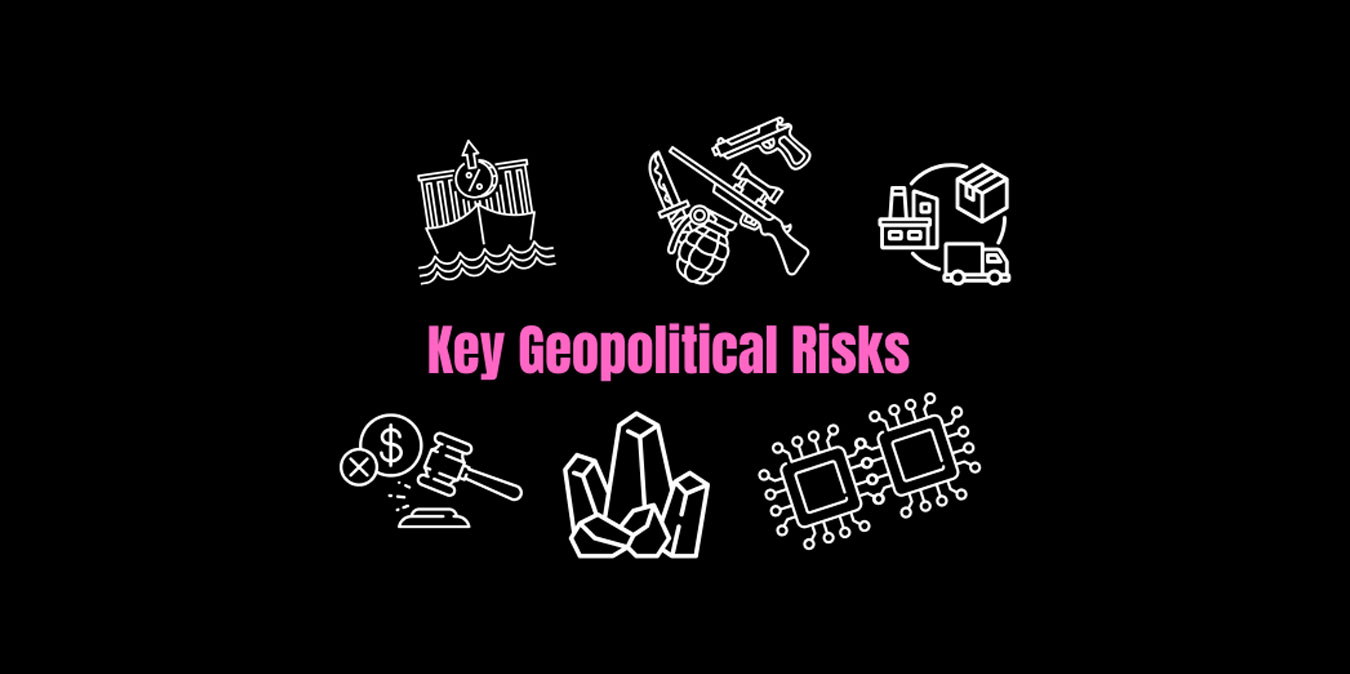
As geopolitical volatility becomes more fragmented and targeted, law firms should be acutely aware of several high-impact risk categories shaping client outcomes in 2026:
- Tariff and Trade Tensions The resurgence of targeted, sector-specific tariffs and trade restrictions continues to disrupt pricing, sourcing, and contract performance. These measures increasingly form the basis of force majeure claims, renegotiation efforts, and disputes—requiring firms to assess whether tariffs genuinely caused loss or merely coincided with broader market pressures.
- Armed Conflict Ongoing and emerging armed conflicts across multiple regions create legal risk tied to operational continuity, asset impairment, and contractual non-performance. Firms advising clients in affected regions must distinguish between direct causation and pre-existing vulnerabilities when geopolitical events are cited as justification.
- Supply Chain Fragility Global supply chains remain fragile, with geopolitical events often blamed for disruption. Courts and insurers, however, are asking whether disruptions stemmed from geopolitical shocks or from structural weaknesses already present within the supply chain.
- Shifting Sanctions Regimes Sanctions regimes continue to evolve rapidly, often with retroactive or extraterritorial effects. Law firms must navigate complex compliance obligations while ensuring that alleged sanctions-driven losses can be substantiated with evidence rather than assumption.
- Critical Mineral Weaponization Critical minerals—essential for defense, energy, and technology—are increasingly weaponized in geopolitical strategy. Export controls, access restrictions, and national security measures raise legal, ethical, and valuation challenges for clients operating in these sectors.
- The Global “Chip Wars” The intensifying semiconductor conflict between the United States and China is reshaping global technology supply chains. Restrictions on chips, manufacturing equipment, and intellectual property increasingly influence transactions, compliance strategies, and litigation exposure.
Each of these risks creates legal complexity. But complexity alone is not the danger.
The danger lies in citing geopolitical risk as causation when it may only be correlation.
The Assumption Trap
Across matters involving tariffs, sanctions, armed conflict, supply disruptions, and technology controls, a recurring issue has emerged: geopolitical risk is often invoked as an explanation without being analytically tested. Courts, insurers, and counterparties are increasingly asking:
- Did the geopolitical event actually change outcomes?
- Was the loss already trending before the event occurred?
- Were alternatives or mitigation strategies available?
- Can the claimed impact be isolated from broader market forces?
When these questions cannot be answered with data, legal positions weaken—and advisory risk shifts back to the firm.
Why Forensic Risk Intelligence Is Becoming Essential
This is where advanced forensic accounting plays a critical role in modern legal practice. At Ampcus Forensics, geopolitical risk is treated as a testable hypothesis, not a narrative. Through forensic analysis, law firms are able to:
- Validate whether a geopolitical event was truly causative
- Quantify financial exposure using accepted, defensible methodologies
- Stress-test assumptions embedded in pleadings, claims, and advisory opinions
- Support client decision-making with evidence that withstands scrutiny
- Reduce hindsight-based professional liability risk
Forensic rigor does not replace legal judgment—it strengthens it.
Latin America: A 2026 Case Study in Risk Convergence
Nowhere is the convergence of geopolitical, operational, and legal risk more visible than in Latin America.
As Carlos Rivera of Ampcus Forensics observes: “Latin America will be a very interesting place to conduct business in 2026. We are already seeing an increase in risk management concerns that could lead to significant legal risk.”
Across the region, law firms are navigating regulatory unpredictability, currency controls, infrastructure fragility, political transition risk, and sanctions adjacency. For clients, these risks already affect performance and compliance.
For law firms, the imperative is clear: prove impact, not just volatility.
The Law Firm Imperative in 2026
The most resilient law firms in 2026 will recognize a simple truth: If your advice relies on geopolitical risk, you inherit the burden of validating it.
Embedding forensic risk intelligence into litigation strategy, insurance recovery, regulatory advisory, and firm-level risk management is no longer optional. It is how firms protect clients, strengthen defensibility, differentiate sophistication, and manage their own exposure.
Final Thought
Geopolitical risk is not just reshaping global business. It is reshaping how law firms are judged. The firms that succeed in 2026 will be those that can distinguish real risk from assumed risk—and prove the difference.
That distinction is no longer political. It is forensic.
If your firm is interested to learn more about how process and how we help reduce risk, contact us.